
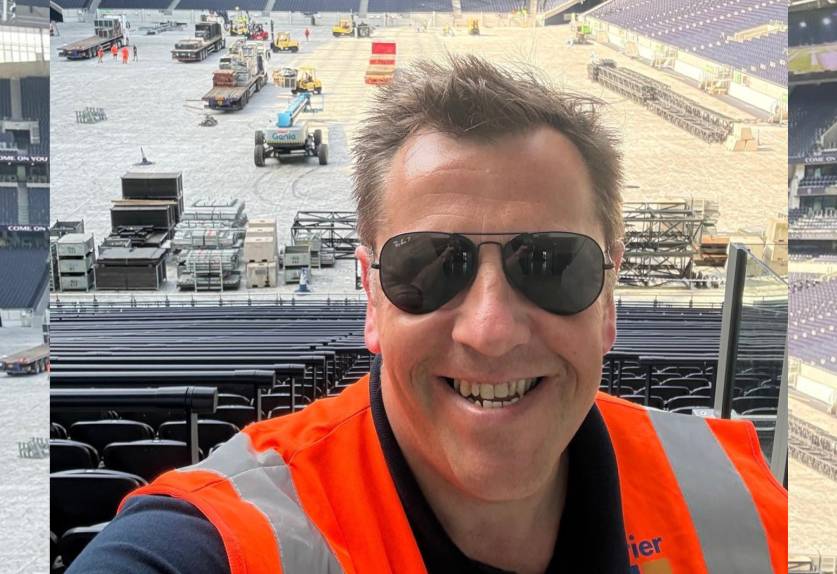
From temporary structures and tight build schedules to multiple contractors working on site, event builds share many of the same risks as construction projects.
In this Q&A, we interviewed one of our operations managers, Dave, about the importance of the Construction (Design and Management) Regulations and what the events industry can learn from construction to create safer, more compliant sites.
Dave, can you tell us a bit about your background in construction and site safety?
“I’ve worked in construction for around 12 years. My first role in the industry was with Balfour Beatty on a £265M civils scheme, constructing a new water treatment works in Devon. Since then, I’ve worked on civils, property development, renewable energy, highways, earthworks and nuclear projects.”
What does CDM mean, and why is it so important—especially for those who may not have heard of it?
“The Construction (Design and Management) Regulations 2015 are the backbone of health and safety requirements within the construction and events industries. It’s important to understand these regulations, as they outline many legal requirements that do not apply in other industries.
“For example, notifying the HSE using an F10 form when a project meets certain parameters, or ensuring the correct people are discharging their duties properly, such as the Principal Designer and Principal Contractor.
“Certain duty holders have obligations under the regulations, and it’s important that these are met to ensure regulatory compliance.”
What are the biggest differences between CDM on a traditional construction site and CDM on an event site?
“There should be no real differences, as the legislation applies across both industries.
“However, it’s acknowledged that the Client, Principal Designer and Principal Contractor don’t always work as fluidly in events as they do on traditional construction projects. The HSE has some great examples of how these duty holders are identified in events, helping to ensure the legislation is applied appropriately.
“From an operational and delivery perspective, the biggest differences noticed on the ground are a lack of competency and poor risk-assessment compliance. It’s easy to see that the events industry relies heavily on large numbers of temporary workers, and their lack of knowledge is often noticeable.
“Risk assessment is also very often treated as a tick-box exercise. When individuals are challenged about certain behaviours, they often don’t even know the contents of their own risk assessments.”
Why should event organisers think about the risks associated with on-site builds and breaks in a similar way to risks on a construction site? What could the events industry learn from the construction industry?
“As mentioned above, competency should be checked at all levels to ensure that each person can do the job expected of them. From manual handling to working-at-height training, organisations should check that personnel have completed the relevant training, which is readily available online at very little cost.
“The events industry should go further when appointing contractors to ensure that they are investing in their staff and providing appropriate training. The construction industry has many schemes in place, such as CSCS. Until the big players in the events industry recognise the value of these practices, things may never change.
“Start using risk assessments and safe systems of work as the foundation for how work is planned and delivered, with site managers and health and safety advisers carrying out assurance activities to ensure they are being followed.
“If those systems need to change, work should stop so that the task can be reassessed dynamically, with any changes recorded before work resumes.”
What are some practical changes event organisers could implement now to improve their approach to CDM?
“Harrier puts highly experienced and qualified safety advisers at the forefront of your business operations, ensuring legal compliance is satisfied from a documentation perspective and then carrying out assurance activities to confirm that the measures put in place are suitable and sufficient.
“Having an adviser on site should not be seen as policing. They should be there in an advisory capacity—to do just that.”
How do you see CDM changing within the events industry over the next few years?
“Unless there are significant changes to regulations and guidance, things may not change. However, if the frequency of incidents and accidents increases, we might see changes in behaviours on site.
“The more we shout about it now and aim for a proactive approach instead of a reactive one, the more we can help protect our people and, in turn, our businesses!”
If you’d like support with CDM compliance, event safety planning or any of the topics covered in this blog post, our team is here to help. Get in touch today to find out how we can support your next event.